


ETAC Testing Corse
Automotive Testing
Automotive environmental testing that supports the reliability of all electronic components
Modern automobiles are equipped with more than 100 ECUs and semiconductor devices per vehicle. From engine control to ADAS (Advanced Driver Assistance System), numerous electronic components work together, and reliability is required to ensure reliable operation even under harsh environmental conditions such as temperature, humidity, vibration, and shock. ETAC's environmental test facilities can reproduce actual driving environments to comprehensively evaluate the durability, quality, and safety of electronic components and in-vehicle devices.
Standards Compliance and Global Standards
Compliance with international standards enables us to provideGlobal Quality AssuranceThe company will realize the following.
- ISO 16750 SeriesEnvironmental conditions/testing of automotive electrical components
- JASO D014Environmental Test Methods for Automotive Parts
- IEC 60068 seriesEnvironmental testing of electronic equipment
- UN/ECE R100 and R136EV battery-related safety requirements
Additional needs in the EV/ADAS era
- High voltage system (battery/inverter)Insulation reliabilityThermal runaway related evaluation
- Sensing (camera/radar/LiDAR)Weather, thermal shock and noise resistance
- Connected/Communication Module'sTemperature x Vibration Compositeand communication stability
- Includes cyber/power fluctuationsPower quality and malfunction riskComprehensive verification of
Advantages of Pilot Introduction
- Early detection of defects before mass productionDesign optimization and quality cost reduction
- Visualization of life span and deteriorationAdvancement of warranty design and maintenance planning through
- Improved brand credibilityand facilitation of certification
Advantages of hiring ETAC
1. one-stop testing for a wide variety of tests
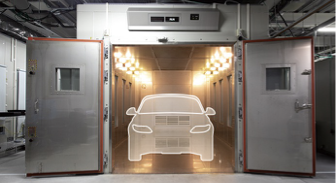
We have a system in place to conduct multiple environmental load tests such as temperature, humidity, vibration, shock, and corrosion all at once. We also have a large environmental testing room where tests can be conducted not only on parts and in-vehicle components, but also on vehicles themselves, allowing us to flexibly respond to complex environmental conditions and streamline our development schedule.
Main test subjects and evaluation areas
| field | Main target devices and systems | Main Test Contents |
|---|---|---|
| Engine & Powertrain | ECU, Inverter, BEV/HEV electrification components, Bat control, TFT/Film capacitor, etc. | High/low temperature, temperature cycling, thermal shock, continuous endurance, vibration (running/engine) |
| In-vehicle/outside communications | Telematics, navigation systems, communication modules, inter-vehicle/inter-road communication | Temperature and humidity cycles, weather resistance, electromagnetic noise effect check, condensation evaluation |
| Brake control | ABS, electric brakes | Combined temperature × vibration environment, shock, rapid cooling and heating cycles, long-term repetition |
| Visibility and light control | Cameras, headlights, HUD, various sensors | Retention of optical performance, thermal shock, weather/ultraviolet, low temperature startup |
| Safety/Comfort Control | Airbags, seatbelts, HVAC, occupant detection, parking assistance | High temperature, high humidity, low temperature, salt spray, long-term stability, material degradation |
| driveability | Motor, EPS, suspension, various control units, harnesses | Vibration (multi-axis), salt spray/corrosion, dust, high/low pressure, water resistant |
Typical Environmental Test Menu

High Temperature Storage (HTS) is a test that evaluates the service life, performance degradation, heat resistance, and long-term reliability of products and materials in a short period of time by intentionally accelerating aging through prolonged exposure to high temperatures.

Low Temperature Storage (LTS) is a test that evaluates the service life, performance degradation, heat resistance, and long-term reliability of products and materials in a short period of time by intentionally accelerating aging through prolonged exposure to low temperatures.

High Temperature Operating (HTO) Test is conducted to accelerate the degradation of products and materials by continuously applying voltage and current while exposing them to high temperatures. It is used to detect defects and to verify reliability and durability.

High Temperature Operating (HTO) Test is conducted to accelerate the degradation of products and materials by continuously applying voltage and current while exposing them to high temperatures. It is used to detect defects and to verify reliability and durability.

Temperature Cycling Test (TCT) is conducted to evaluate the durability and reliability of products and materials by alternately exposing them to high and low temperatures.This process accelerates degradation and failures caused by thermal expansion and contraction due to temperature changes.

Thermal Shock Test (Liquid Bath Type, TST) is conducted to detect and evaluate early defects and weaknesses such as cracks, delamination, and deformation by alternately immersing products and materials in hot and cold liquids to impose extreme temperature changes.
For environmental testing of automotive components and in-vehicle equipment,Scientific approach to assure safety, reliability, and long-term qualityThis is the first time that we have conducted a test of our products. We combine a variety of tests to verify that our products can perform in all usage environments around the world, supporting the peace of mind of next-generation mobility.